
You don’t always need an X-ray before chiropractic treatment, but in many cases imaging provides important information that makes care safer and more effective. The right answer depends on your specific situation: your symptoms, your history, your age, and any red flags that show up during examination. A good chiropractor doesn’t take X-rays on every patient by default, but also doesn’t skip them when they genuinely matter. Here’s how we think about it at our Oklahoma City practice.
The Short Answer: It Depends on You
There’s a lot of confusion around chiropractic X-rays, and some of it is justified. You may have heard that some clinics X-ray every single patient automatically, or conversely that X-rays are never necessary. Both of those positions are too simple.
The honest answer is that imaging is a clinical decision, made based on what your individual case requires. For some patients, an X-ray reveals information that’s essential for safe, effective treatment. For others, the history and examination provide everything needed, and imaging would add nothing.
The principle I’ve followed for 23 years is straightforward: we do not guess, we test. Sometimes that testing includes imaging, and sometimes it doesn’t. What matters is making that decision based on your actual clinical picture, not on a blanket policy.
When an X-Ray Genuinely Matters
There are real situations where imaging before treatment is the responsible choice. Here are the main ones.
After Trauma or Injury
If you’ve been in a car accident, had a fall, or experienced any significant trauma, imaging helps rule out fractures and assess for structural damage before any hands-on treatment. This is especially important with accident injuries, which is why imaging is a standard part of how we evaluate accident patients. You can read more about this in our post on what to do after a car accident.
Red Flags in Your History or Exam
Certain findings warrant imaging before treatment: a history of cancer, unexplained weight loss, signs of infection, significant neurological deficits, or pain that doesn’t behave like typical mechanical pain. These red flags are exactly what a thorough examination is designed to catch, and when they appear, imaging is part of responsible care.
To Understand Your Spinal Structure
For some conditions, seeing the actual structure of your spine changes the treatment approach. Significant arthritis, degenerative changes, alignment issues, or congenital variations can all affect how we approach your care. Knowing about them in advance lets us tailor treatment safely. For example, the technique and force used on a spine with advanced degeneration differs from what’s appropriate for a healthy young spine.
Older Patients and Bone Health Concerns
In older patients or those with risk factors for osteoporosis or other bone conditions, imaging helps ensure that treatment is appropriate and safe for the condition of the bones being worked on.
When You Probably Don’t Need One
On the other hand, plenty of patients don’t need imaging to begin care safely.
If you’re a relatively healthy adult with straightforward mechanical pain, such as a recent muscle strain or typical low back pain with no red flags, a thorough history and physical examination usually provide everything needed to begin conservative treatment safely. In these cases, jumping straight to an X-ray would expose you to radiation without adding meaningful value.
Good clinical practice means using imaging when it informs care and skipping it when it doesn’t. Routinely X-raying every patient regardless of need isn’t sound practice, and it’s part of why the topic has earned some skepticism.
Why On-Site Digital X-Rays Make a Difference
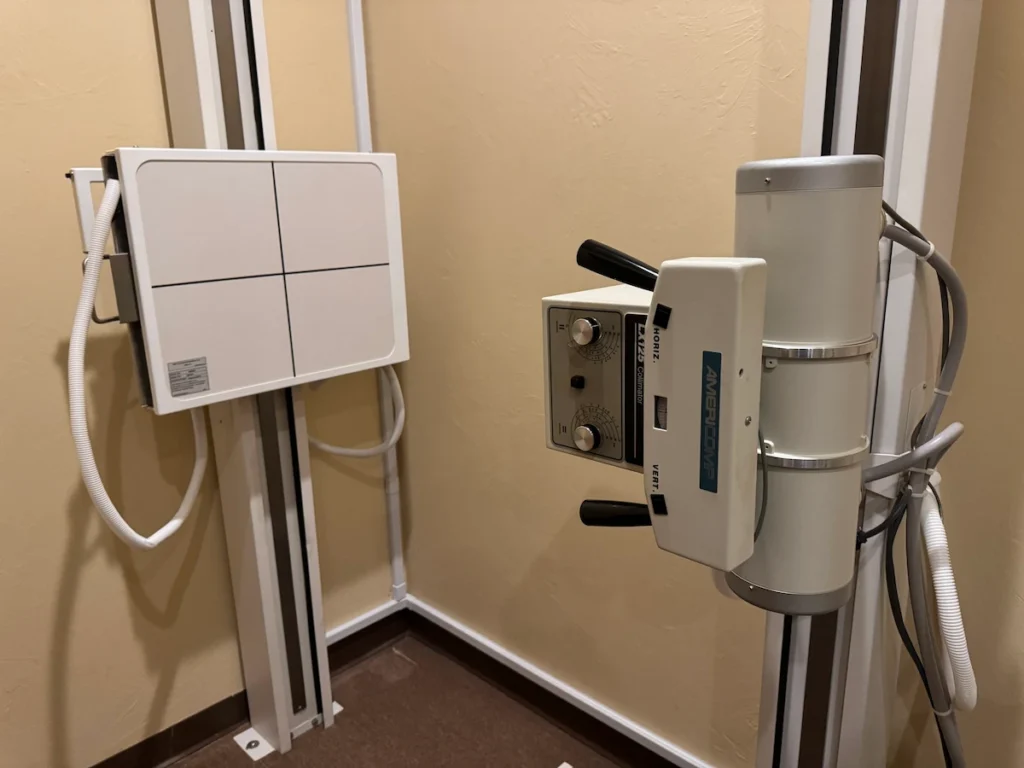
At Family Tree Chiropractic, we have on-site digital X-ray capability, which matters for a few reasons.
First, when imaging is needed, we can do it during your first visit rather than sending you elsewhere and waiting days for results. That means we can begin appropriate treatment faster. Second, modern digital X-ray uses significantly lower radiation than older film systems while producing clearer images. Third, having the imaging in-house lets us correlate exactly what we see on the image with what we find on examination, which leads to more accurate diagnosis.
The clearest picture on the first visit allows us to be confident about what we’re treating and how to treat it. That’s the value of testing before treating rather than working from assumptions.
The Bigger Principle: Test, Don’t Guess
X-rays are just one tool in a larger philosophy. The reason we emphasize testing isn’t about any single piece of equipment. It’s about not making assumptions when it comes to your health.
When you come to our Oklahoma City clinic, the evaluation includes a comprehensive history, orthopedic and neurological examination, range-of-motion and muscle testing, and imaging when your case calls for it. All of that information together is what allows us to find the true root cause of your problem and build a treatment plan that addresses it. This thorough diagnostic foundation is the starting point of the R.E.S.T.O.R.E. Method, whether your care involves chiropractic adjustments, decompression, or other therapies.
The alternative, treating based on guesswork, is how patients end up getting the wrong treatment or having underlying issues missed. We’d rather understand your situation fully before we begin. You can learn more about how Dr. Carter approaches diagnosis and care on the Dr. Micah Carter bio page.
What to Expect at Your First Visit
If you’re new to our practice, here’s how it works. We start with a thorough conversation about your symptoms, history, and goals. Then comes a complete physical examination. Based on what we find, we’ll determine whether imaging is appropriate for your case and explain why.
If we recommend an X-ray, we’ll tell you specifically what we’re looking for and why it matters for your treatment. If we don’t think you need one, we won’t take one. Either way, you’ll understand the reasoning, and you’ll never be left wondering whether a test was truly necessary.
Frequently Asked Questions
Are chiropractic X-rays safe?
Modern digital X-rays use low levels of radiation, and when imaging is clinically appropriate, the benefit of the information far outweighs the minimal risk. The key is using X-rays when they’re genuinely needed rather than routinely, which is the approach we follow.
Will I have to pay extra for an X-ray?
Imaging costs depend on your situation and insurance coverage. For new patients, our $49 comprehensive special includes X-rays as part of the initial evaluation. We’re always transparent about any costs before proceeding.
Can I bring X-rays or an MRI I already have?
Absolutely, and we encourage it. If you’ve had recent imaging from another provider, bringing those results can prevent unnecessary duplicate imaging and give us valuable information for your evaluation.
What if I don’t want an X-ray?
We’ll discuss your concerns openly. In cases where imaging is clinically important for your safety, we’ll explain why. In cases where it’s optional, the choice is yours. We want you informed and comfortable with every step of your care.
Have Questions About Your Care? Let’s Talk
Whether you need imaging or not, the foundation of good chiropractic care is a thorough evaluation that understands your specific situation. Family Tree Chiropractic in Oklahoma City takes the time to test before we treat, so you can be confident your care is built on a clear picture rather than guesswork.
Call us at (405) 340-4400 or schedule your appointment online. New patients receive our $49 comprehensive special, including consultation, adjustment, X-ray, cold laser, and a massage voucher.