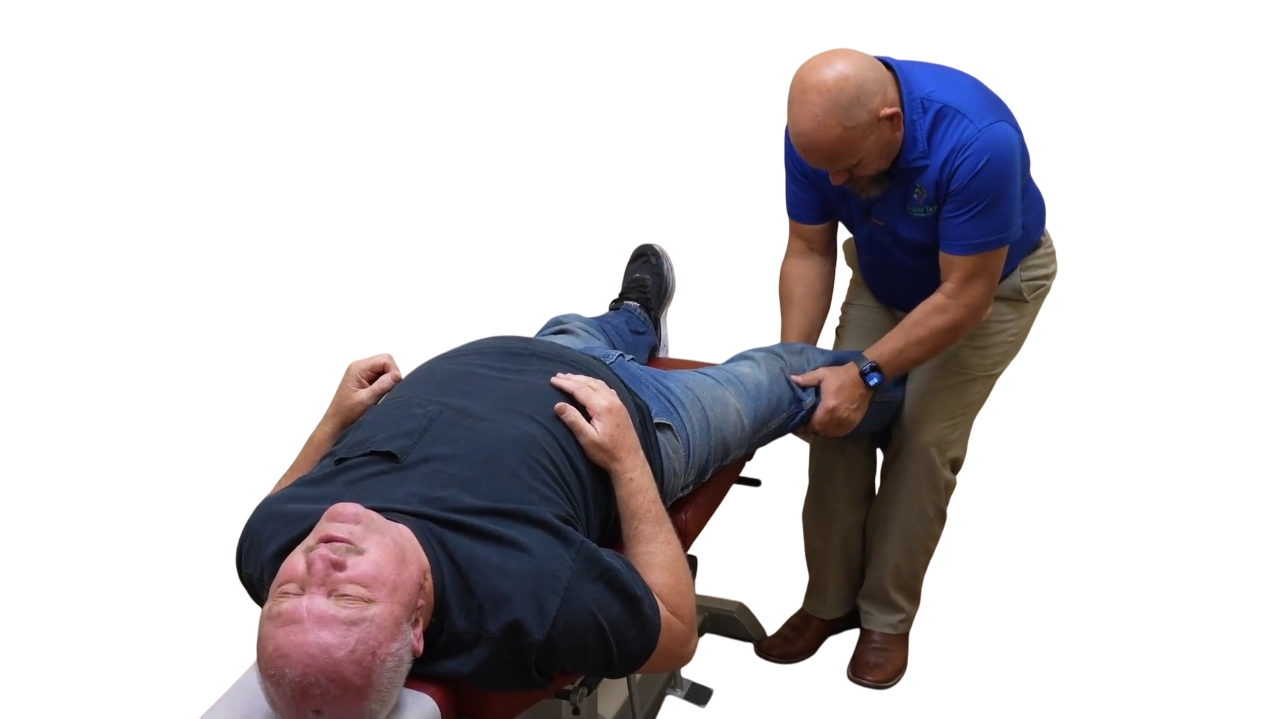

Tech neck, also called text neck or forward head posture, causes chronic neck pain, headaches, and shoulder tension from long hours on phones and computers. At Family Tree Chiropractic in Oklahoma City, Dr. Micah Carter treats the joint restrictions and muscle imbalances that develop from looking down at screens, then retrains your posture so the problem doesn’t keep coming back. Many patients notice significant relief within 3 to 4 weeks of starting treatment.
What Is Tech Neck?
Tech neck describes the neck pain and posture problems that develop from constantly looking down at phones, tablets, and laptops. Your head weighs about 10 to 12 pounds in a neutral position, but as it tilts forward and down, the load your neck has to support rises sharply.
A widely cited 2014 computer-model study estimated that a 15-degree forward tilt puts about 27 pounds of force on the neck, 30 degrees about 40 pounds, and 45 degrees, common when using a phone, about 49 pounds.
Hold that position for hours every day, and your neck muscles, ligaments, and joints become strained and irritated. Pain develops, headaches start, and your posture gets worse, creating a cycle that’s hard to break without help.
Common Symptoms of Tech Neck
Patients with tech neck typically have pain at the base of the skull and upper neck. The pain often spreads into the shoulders and between the shoulder blades, and it’s usually worse when looking up or turning the head.
Headaches are very common with tech neck. Constant tension at the base of the skull can trigger tension headaches and cervicogenic headaches, and in people prone to migraines, the strain can be a trigger.
Shoulder tension and upper back pain go hand in hand with tech neck. As your head moves forward, your shoulders round forward too. The muscles between your shoulder blades get overstretched and weak, while your chest muscles get tight.
Beyond Pain: Other Effects
Tech neck affects more than your neck. Forward head posture changes how your whole spine carries load, and lower back problems can develop as your body compensates.
Some people notice numbness or tingling in their arms and hands. Forward head posture can irritate nerves that run from the neck into the arms, and these symptoms deserve a careful evaluation.
Breathing can be affected too. A rounded, forward posture limits chest expansion, which may make breathing less efficient and leave some people feeling more tired.
Why Tech Neck Is Becoming an Epidemic
I see tech neck constantly in my Oklahoma City practice. Office workers, students, and anyone who spends long hours on screens can develop these problems, and many people spend several hours a day on their phones before counting work computer time.
Remote work made it worse. People working from home often have poor ergonomic setups, since kitchen tables and couches aren’t designed for eight hours of computer work.
Younger people are developing tech neck earlier than previous generations. I’m seeing teenagers and even children with forward head posture and chronic neck pain. Their spines are still developing, which makes early attention important.
How Chiropractic Care Corrects Tech Neck
Treating tech neck means addressing both the symptoms and the root cause. Pain relief comes first, then we correct the underlying posture problems.
Chiropractic adjustments restore motion and alignment to the cervical spine. Forward head posture tends to create restrictions in the upper neck that irritate nearby nerves and strain the joints.
Adjustments help ease that irritation and restore normal joint function. Many patients notice relief soon after their first adjustment as muscles relax, range of motion improves, and pain decreases.
The R.E.S.T.O.R.E. Method for Postural Correction
At Family Tree Chiropractic, we use our R.E.S.T.O.R.E. Method for lasting postural correction. Adjustments alone provide temporary relief, but without addressing muscle imbalances and movement habits, forward head posture tends to return.
We release the tight muscles that pull your head forward. The suboccipital muscles at the base of your skull, the upper trapezius, and the chest muscles all get chronically tight with tech neck, and massage therapy and targeted stretches release that tension.
We strengthen the weak muscles that should support good posture. The deep neck flexors, rhomboids, and lower trapezius get weak with forward head posture, and specific exercises rebuild them so they can hold correct alignment.

Neuromuscular Re-Education
Here’s the key that most treatments miss. Your brain has learned the forward head position as “normal.” Even after we improve alignment and release tight muscles, your nervous system tries to return to that familiar position.
Neuromuscular re-education retrains the brain-muscle connection. Through specific exercises and posture awareness training, you develop new movement habits, and your nervous system learns to hold a better head position automatically.
This is the difference between temporary relief and lasting correction. Without retraining, it’s easy to drift back into forward head posture within weeks.
Cold Laser Therapy for Neck Pain
We use cold laser therapy to help calm inflammation and support healing in strained neck tissues.
Cold laser can be especially helpful for the chronic muscle strain that develops with tech neck. It’s painless, takes just a few minutes, and pairs well with adjustments.
Many patients notice less neck stiffness and pain after adding cold laser to their plan, and combining adjustments, muscle work, and laser therapy often helps patients progress faster.
Ergonomic Corrections for Office Workers
Fixing your posture while continuing the same habits that caused tech neck doesn’t work long term. We provide specific ergonomic recommendations for your workspace.
Monitor height matters a lot. Your screen should let you look straight ahead rather than down, with the top of the monitor at or slightly below eye level.
Chair height and desk setup need attention too. Your feet should rest flat on the floor with knees at about 90 degrees, and your forearms should rest roughly parallel to the floor when typing. These small changes reduce postural stress significantly.
Phone Usage Modifications
Hold your phone closer to eye level instead of looking down at it. It feels awkward at first but becomes natural quickly, and the reduction in neck strain is significant.
Take frequent breaks from screens. The 20-20-20 rule helps: every 20 minutes, look at something 20 feet away for 20 seconds. This breaks up the constant forward head position and lets your neck muscles rest.
Voice-to-text features reduce the time you spend looking down at your phone, so use them for messages and emails when you can.
Exercises You Can Do at Home
I provide specific exercises to do between office visits. They’re essential for maintaining the progress we make during treatment.
Chin tucks strengthen your deep neck flexors and retrain head position. Pull your chin straight back without tilting your head up or down, hold for 5 to 10 seconds, and repeat 10 times, several times a day.
Doorway chest stretches release the tight chest muscles that pull your shoulders forward. Stand in a doorway with your forearms on the frame, then lean forward gently until you feel a stretch across your chest.
Shoulder Blade Squeezes
This exercise strengthens the rhomboids and middle trapezius between your shoulder blades. Squeeze your shoulder blades together and down, and hold for 5 seconds. These muscles are usually weak with forward head posture.
Done correctly and consistently, these exercises speed up your recovery and help you maintain good posture long term. I’ll show you how to perform each one with proper form, and you should stop any exercise that causes sharp pain, numbness, or tingling.
How Long Does Treatment Take?
Many patients see significant improvement within 3 to 4 weeks. Pain and headaches often ease within the first week or two, while postural correction takes longer.
Severe tech neck that’s been developing for years needs more time. We typically start with 2 to 3 visits per week for the first few weeks, then taper to weekly as you improve.
Total treatment time averages 8 to 12 weeks for lasting correction, including the initial intensive phase and the transition to managing your posture with home exercises.
Why Some Cases Need More Time
If you’ve had forward head posture for many years, the tissue changes are more significant. Ligaments have adapted to the forward position, and some muscles have weakened while others have become chronically tight. Full correction means rebuilding healthy tissue and habits.
People who can’t or won’t change their work setup tend to progress more slowly. If you continue spending eight hours a day in poor posture, it’s an uphill battle, while ergonomic changes can speed recovery significantly.
When to See a Doctor Promptly
Get checked promptly if neck pain comes with numbness or weakness that’s getting worse, clumsiness in your hands, trouble with balance, a severe headache unlike any before, or fever. These symptoms point to something more than posture and need a medical evaluation.
Preventing Tech Neck from Returning
Once your posture improves, maintaining it becomes a daily practice. Awareness is the first step: notice when your head drifts forward and correct it.
Regular exercise helps maintain your postural muscles. Swimming, yoga, and Pilates are especially helpful because they strengthen the core and upper back while improving body awareness.
Periodic maintenance adjustments help catch small problems before they become big ones. Many patients benefit from monthly or every-other-month visits after completing their intensive treatment phase.
Real Patient Success Stories
I treated a software developer who spent 10 to 12 hours a day at his computer. He came in with constant neck pain, daily headaches, and couldn’t turn his head more than 45 degrees in either direction.
We started with adjustments three times a week, cold laser therapy, and specific exercises, and we redesigned his workspace. After four weeks, his pain dropped from an 8 to a 3. After eight weeks, he was essentially pain-free with full range of motion.
Another patient, a high school student, developed severe neck pain and headaches from constantly looking down at her phone. Her head sat nearly three inches in front of where it should be.
With consistent treatment and education about phone habits, her posture improved dramatically and her headaches resolved. She learned to hold her phone closer to eye level and take regular breaks. Every case is different, and results vary.
Why Choose Family Tree Chiropractic
My background as a teacher shows in how I approach patient care. I don’t just adjust you and send you out the door. I explain what’s wrong, why it happened, and how to keep it from coming back.
Understanding your condition helps you take control of your health. You’ll learn to recognize when your posture starts slipping and correct it before pain develops.
We have our core treatment options under one roof: chiropractic adjustments, cold laser therapy, therapeutic massage, and rehabilitation exercises, all coordinated and customized for you.
Frequently Asked Questions
Can tech neck be reversed?
In many cases, yes. Consistent care, exercises, and better screen habits can noticeably improve forward head posture and relieve pain, even after years.
How do I know if I have tech neck?
Common signs include pain at the base of the skull, headaches, tight shoulders, and a head that sits forward of your shoulders when viewed from the side. A posture exam can confirm it.
Do posture correctors help tech neck?
They can serve as short-term reminders, but strengthening exercises and better habits are what create lasting change.
Getting Started with Treatment
Your first visit includes a comprehensive evaluation of your posture, spinal alignment, range of motion, and muscle balance. Digital X-rays show spinal alignment and any degenerative changes when needed.
On your second visit, I sit down with you for a detailed report of findings. You’ll see what we found and understand the treatment plan, with clear explanations based on objective findings.
Our $49 new patient special includes your consultation, examination, first adjustment, X-rays if needed, cold laser therapy, report of findings, and a massage voucher.
Don’t let tech neck become a chronic problem. Call Family Tree Chiropractic at (405) 340-4400 today to schedule your evaluation with Dr. Carter. We’ll identify the root cause of your neck pain and create a treatment plan for lasting relief. Visit our contact page to book online.
Family Tree Chiropractic in Oklahoma City is committed to advancing patient health through innovative and compassionate chiropractic care. Led by Dr. Micah Carter, our team integrates modern techniques such as shockwave therapy with a holistic approach to pain relief and wellness. We believe in empowering our patients with comprehensive treatment options that address the root causes of pain and promote long-term health and vitality.